- NEXTBULL Masterclass
- Posts
- How Long Does It Take To Extract $1.3 Million From Retail Investors?
How Long Does It Take To Extract $1.3 Million From Retail Investors?
This is not a cautionary tale. The wallets are public. The timestamps are on-chain. The sequence has been documented by three separate blockchain analytics firms.

Shogun Saski
April 02, 2026
What happened on December 4, 2024 has a name, a structure, and a repeating cast of characters. It ran the same way the time before that. It is running somewhere right now under a different name with a different wrapper.

Here is the case file.
Every token launch that follows this pattern begins the same way, in a private room retail investors are never invited into.
Weeks before the public launch, the token supply is divided. A small allocation typically three to five percent is designated for public trading.
The remainder is distributed among insiders: early investors, strategic wallets, snipers with pre-arranged access, and affiliated addresses funded from a single source.
In the $HAWK launch of December 2024, on-chain data showed only three to four percent of tokens were available to the public, while 96 percent were held by insider wallets before a single retail buyer touched the asset.
This is not an accident. This is the product. The public market exists not to distribute value but to provide exit liquidity for positions already taken.
According to blockchain analytics firm Bubblemaps, 17 percent of the supply was handed to 285 investors at launch, with nearly half selling the bulk of their holdings immediately, collectively netting over $3.3 million.
The public saw a chart going up. The insiders saw a door marked exit.
Phase Two: The Wrapper
A token with nothing inside it needs something on the outside.
The wrapper changes, a viral celebrity one cycle, an odd narrative the next, a geopolitical meme the one after that. The function is identical: attach the token to something that already has emotional momentum, so retail buys the emotion and calls it investment.
In the $HAWK case, pitch decks circulated privately on Telegram promised early investors they would have the opportunity to unload their tokens before the coin went live messages that were later deleted.
The wrapper is not the scam. The wrapper is the packaging. The scam is what was loaded inside before the packaging was sealed.
Across DEX pools analyzed in 2024, approximately 94 percent of suspected pump-and-dump schemes were executed by the address that created the pool.
The same hands that built the token built the exit. They are not separate operations.
Phase Three: The 90-Minute Window
The execution is fast because it has to be. Retail attention is the fuel and it burns quickly.
The $HAWK token launched on December 4, 2024, at 5:00 PM EST. Initial enthusiasm saw the market capitalization reach $490 million.
Within hours, the value fell 91 percent. That window from launch to collapse is where the entire operation lives.
Data from the Solana block explorer Solscanner shows that one wallet acquired 17.5 percent of the HAWK supply seconds after launch, purchasing the tokens for approximately $993,000. In the following 90 minutes, that wallet sold 135.8 million HAWK tokens, netting a profit of $1.3 million.
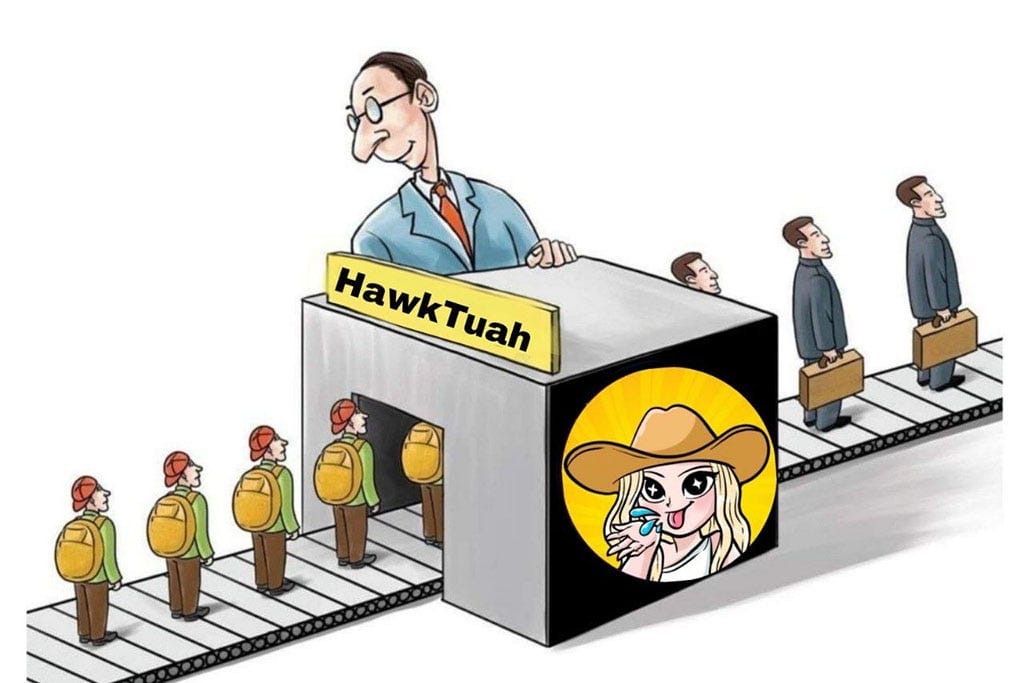
Ninety minutes. The retail investor who saw the chart at the peak, felt the FOMO, clicked buy, and checked the price an hour later had already been processed.
Their purchase was not an investment. It was the mechanism by which someone else’s position was liquidated.
The Chainalysis 2025 report identifies that 3.59 percent of all tokens launched in 2024 exhibited patterns consistent with pump-and-dump schemes and that figure captures only the detectable cases.
The ones that left enough on-chain footprint to flag. The cleaner operations leave less.
Phase Four: The Denial Script
After every execution, the script runs.
The team issues a statement. They did not sell. They were not involved. The market was volatile. Snipers are a known risk in crypto. They tried to prevent it. The technology is complex. They cooperated with authorities.
Welch denied involvement, stating she was only a paid promoter who cooperated with the SEC and FBI, and was not named in the lawsuit.
The people who built the token structure, distributed the insider allocations, and coordinated the wallets issued similar statements. None of it changes what the blockchain recorded.
The denial is the final phase of the operation. It buys time, diffuses accountability, and ensures the next version of the same scheme can launch under a different name with a different wrapper before any regulatory consequence arrives.
Cross-chain pseudonymity and AMM-driven markets make such schemes difficult for legacy monitoring tools to detect. The architects know this. They designed the operation around it.
What The Data Tells You
The pattern is not random. The timing is not coincidence. The wallet concentration, the private allocation, the celebrity or narrative wrapper, the 90-minute extraction window, the identical denial these are not separate failures.
They are sequential steps in a documented process that has been run dozens of times and will be run dozens more.
The only variable that changes is the wrapper. The AI token, the meme coin, the exchange listing, the influencer launch these are costume changes. Underneath each one, the structure is identical.
Three percent for you. Ninety-six percent for them. Ninety minutes to extract it.
The case file does not require your outrage. It requires your attention. Learn to read the wallet concentration before the launch. Check who funded the deployer address.
Look at what percentage of supply is actually available to the public. These numbers are on-chain. They were there before the chart moved. They are always there.
The people who already know how to read them are at https://t.me/nextcryptorebellion.
That is where this kind of intelligence gets shared before the 90-minute window opens not after it closes.